
The act of crossing a threshold
There are gestures we perform without thinking about them, yet which deserve our full attention.
Crossing a threshold is one of them.
Sometimes, just a few centimetres are enough to leave one world and enter another.
Outside: the street, movement, noise, stimuli, the unexpected. A space open to everyone, crossed by flows and activities in which we participate but which do not belong to us.
Inside: a defined, deliberate, composed environment. Light, temperature, materials, scents, acoustics, proportions, a particular way of moving through the space and of being welcomed.
The body has moved only a few steps.
The experience itself has changed in nature.
The threshold is more than a boundary
Japanese thought offers a beautiful word through which to approach this idea: kekkai.
In The Beauty of the Threshold – Japanese Aesthetics of the Boundary, devoted to the work of Japanese architect Itō Teiji and introduced by Philippe Bonnin, kekkai emerges as far more than a boundary.

It separates, certainly, but it also connects.
It truly exists only because it brings two different spaces into relation and shapes the way we move from one to the other.
The boundary then becomes less a line than an interval: a transitional space, a moment in which something is left behind and something else begins.
This way of thinking about the threshold resonates particularly strongly with Japanese architecture, with its elements that can alternately separate, open, filter and reveal: panels, partitions, blinds, screens, doors, verandas…
Space is not necessarily fixed once and for all. It can be composed, contracted, opened up, change its function and adapt to different uses.
The threshold plays a part in this transformation.
Between outside and inside
Western architecture, too, has long attached considerable importance to the act of transition.
Grand entrances, porticoes, porches, staircases, colonnades, vestibules and monumental doors were not merely decorative devices.
They prepared and marked the passage from one space to another, gradually placing those who entered in a state of mind in which they could experience the building.
Religious buildings are, of course, the most powerful expression of this: symbolically, we leave the profane world behind to enter a sacred space.
Without, of course, attributing such a sacred dimension to a hotel, something of this mechanism remains.
Entering a place is never entirely neutral.
The threshold shifts our perception.
By analogy, we could almost describe it as a transition from a more yang register — movement, exposure, activity, the outside world — towards a more yin register, characterised by inwardness, protection, a slowing of pace and greater attention to the senses.
And it is precisely this transition that I find particularly interesting in a hotel.
Where does the guest experience really begin?
It can rightly be said that the hotel experience begins long before the entrance.
It may begin on a website, on the telephone with the reservations team, or in the exchanges leading up to the stay.
In an upscale hotel, it may continue from the moment the guest’s car arrives: valet parking, luggage assistance, the first gesture of attention towards the guest.
All of this matters.
But crossing the entrance has a different quality.
It is the first moment when the guest physically experiences the world that has been designed for them.
They are no longer looking at it on a screen.
They enter it.
And all their senses begin gathering information simultaneously.
The height of the space.
The light.
The temperature.
The material underfoot and the sound of their footsteps.
The scent of the place.
The sound level.
Perhaps music.
The way the eye is drawn towards a particular point.
The presence — or absence — of a reception desk.
The distance between the guest and the first person who will come to greet them.
All of this happens within a matter of seconds.
Long before the guest consciously forms an opinion, the building has already begun a dialogue with them.
Preparing the transition
This is why the threshold of a hotel should perhaps never be considered simply as the technical resolution of a door within a façade.
It deserves to be conceived as a genuine sequence.
What are we leaving behind?
What do we want to leave behind?
What do we want the guest to feel before they even enter?
Should the entrance be set back from the street?
Should there be a forecourt?
Should we slow the guest’s pace?
Provide shelter from rain and wind?
Pass through a porch?
Allow the light to change gradually?
Should the lobby be revealed immediately or remain concealed for a few more moments?
Should we stage a revelation, suddenly opening the view onto an exceptional landscape?
Should the interior be heard before it is seen?
Should the material beneath the feet change?
Should we create transparency, a filter, a succession of planes?
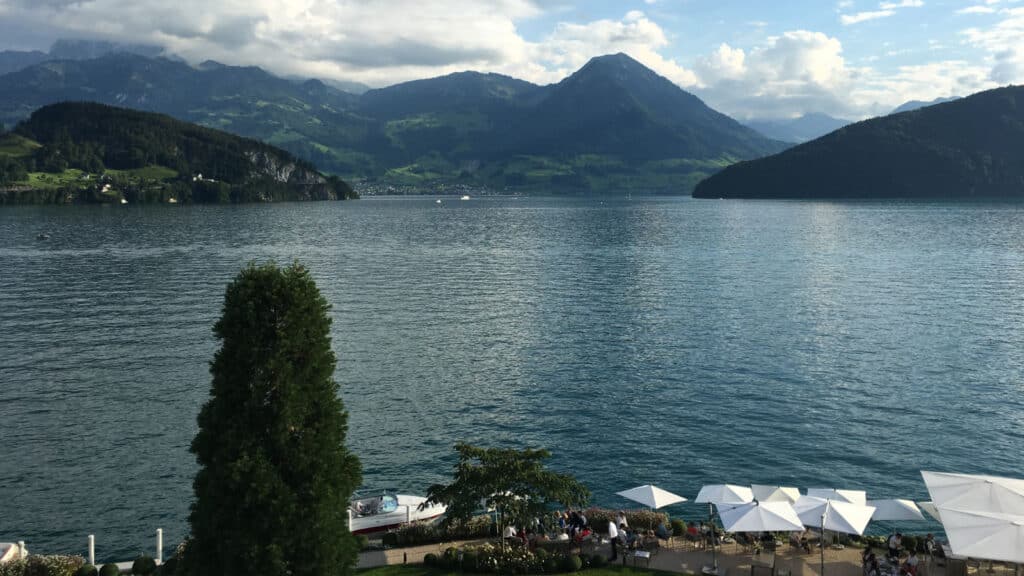
Sometimes, the purpose of the threshold is not to soften the transition but to create a powerful sensory impact. A through-lobby that suddenly frames a lake, the mountains or the sea can create the kind of immediate revelation sought by some hotels: the guest enters, and the landscape itself becomes almost the first gesture of welcome.
I experienced this very strongly when entering the Park Hotel Vitznau: the view over the lake asserts itself with such force that it immediately captures all your attention. The effect is spectacular — almost enough to make you want to step straight back outside and into the landscape.
These are architectural choices, of course. But they are also choices about the brief and the guest experience.
And this is precisely where the question also concerns the client and the project management adviser.
What do we want to reveal at the precise moment of crossing the threshold? A threshold can protect, filter and slow the pace, but it can also frame, unveil and create a sense of wonder.
Before even designing a door, we need to explore what the entrance should say about the place.
A threshold for each new world
The main entrance is, moreover, only the hotel’s first kekkai.
Inside, other thresholds punctuate the experience and progressively change the guest’s relationship with the building.
From the lobby to the bar.
From the lobby to the restaurant.
From public areas to guestroom corridors.
From the corridor to the guestroom.
From the guestroom to the bathroom.
From the clothed world to the spa.
From inside to a terrace, a garden or a swimming pool.
Each time, something changes.
The degree of intimacy.
The light.
The sound.
The temperature.
The materials.
Our relationship with others.
The way the body occupies the space.
The pace.
The hotel thus becomes a world composed of several worlds, each with its own atmosphere, connected by a succession of transitions.
The threshold is no longer simply what separates spaces. It gives physical form to their differences and allows us to perceive them.
Designing for the senses
This perspective also allows us to look differently at what is sometimes rather loosely described as the multisensory experience.
It is not about accumulating effects.
Sight does not need to be stimulated everywhere.
Scent does not need to become an overpowering signature.
Music does not need to fill every silence.
Materials do not need to be spectacular in order to be felt.
Restraint and simplicity are also part of elegance. They leave room for perception, prevent sensory overload and allow each sensation to exist with precision.
Perhaps refinement lies less in profusion than in the coherence with which each sensation accompanies the nature of the space.
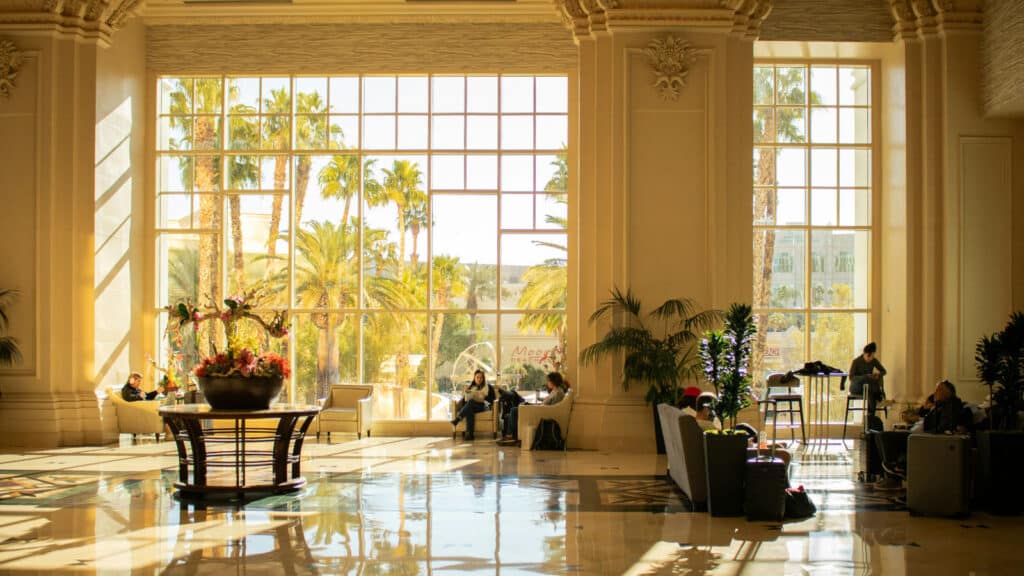
Beauty for the eye.
Flavours for taste.
Textures, fabrics, water or warmth for touch.
Scents for smell.
Acoustics, silence or a few delicately chosen sounds for hearing.
And beyond each of these senses individually, an overall impression: that of having entered a place with an identity of its own, one that knows exactly how to express everything it wants us to feel.
Designing the threshold before designing the door
For the client, architect, designer or project management adviser, the question then becomes very concrete.
Where does the hotel we want to create actually begin?
Not administratively.
Not in cadastral terms.
Not even architecturally.
But in the experience of the person who is about to enter it.
The answer can change the way we design the forecourt, façade, canopy, door, entrance lobby, vestibule, main lobby, lighting, or indeed the relationship between outside and inside.
It can also lead us to pay closer attention to the micro-thresholds that will punctuate the rest of the stay.
Because a truly beautiful hotel is not made up solely of beautiful spaces.
It is also made up of the way we move from one to another.
Kekkai thus reminds us of something contemporary architecture sometimes forgets: a boundary is not necessarily something that stops us.
It can be something that prepares us. That connects. That transforms.
And in a hotel, perhaps this is precisely where the experience begins: in that almost imperceptible moment when the guest is no longer quite outside, without yet being completely inside.
Photo credits
Cover photo: Nekibek / Pexels
Lobby: Zoshua Colah / Unsplash