
Water: a technical issue and a precious resource
As the fifth Carrefour des Gestions Durables de l’Eau takes place in Dijon on 9 and 10 September 2026, I wanted to take some time to explore the best practices and innovations being developed in the hospitality industry.
The opening plenary session posed an ambitious question: “Do we need a new water law?”, with speakers including Érik Orsenna, writer, economist and member of the Académie française.
I particularly like an expression he used about water some years ago: it can be “the sky on earth”. It captures rather well what fascinates me about this subject. Water is infrastructure, a resource, a cost and a technical constraint, but above all it is one of the fundamental conditions of life.
In a hotel, water is everywhere: in showers and baths, of course, but also in kitchens, laundries, swimming pools and spas, washrooms, cleaning, irrigation and technical systems.
The subject therefore deserves more than a catalogue of virtuous measures. And above all, in my view, it deserves to be approached without making people feel guilty.
Using less does not necessarily mean going without
Waste bothers me deeply.
That does not mean, however, that I regard all consumption as inherently problematic. I must confess to a personal departure from perfect water efficiency, as I still enjoy, from time to time, lingering in a good hot bath with a handful of Epsom salts, simply for the pleasure of a moment of deep relaxation.
I digress — but not entirely. Because the interesting question in hospitality is precisely this: do we have to diminish the experience in order to reduce consumption?
I do not believe we do.
In an upscale hotel, asking guests to pay a substantial room rate while providing a shower with such a low flow that it becomes unpleasant would be a rather strange interpretation of resource efficiency.
For the project management adviser, part of the challenge is to help the client determine where to strike the right balance: how far to reduce consumption, where to invest, and at what point savings would begin to compromise the intended guest experience. Before reducing the water guests actually enjoy, it seems far more logical to start by tracking down the water that is genuinely being wasted.
And there is often plenty of it.
The figures published by Dijon Métropole are interesting in this respect. It reports that water production fell from around 25 million m³ for 275,000 inhabitants to 19.8 million m³ in 2021 for a population of around 300,000 — a saving of more than 5 million m³ in just over fifteen years. The reduction therefore cannot be explained by falling demand: it reflects sustained work on networks, leak detection, equipment performance and changing patterns of use.
It is a useful reminder in this context: managing consumption does not depend solely on individual effort.
Before investing, find out where the water goes
The first lever almost seems too simple to qualify as innovation: measurement.
A hotel closely monitors its occupancy rate, RevPAR, staffing costs, energy expenditure and F&B purchasing.
But does it really know how much water is being consumed by each use?
A main meter reading alone does not necessarily reveal what is happening in guestrooms, the kitchen, laundry, spa, swimming pool or irrigation systems.
Sub-metering, regular consumption monitoring and leak detection systems can reveal anomalies that would otherwise remain invisible.
The Riverbank Hotel in Wexford provides a striking example. After benchmarking its consumption against comparable hotels, the property investigated possible leaks. Four were identified and repaired. According to Ireland’s public water utility, the results were remarkable: 13,100 m³ saved annually and a reduction of more than €30,000 a year in the water bill – approximately half of the total.
No futuristic technology was required, and nothing was asked of the guest. Just common sense to begin with: measure, compare and identify anomalies. Followed by a little Sherlock Holmes work to trace the networks, locate the leaks and fix them.
The cumulative effect
Taken individually, a tap aerator, an adjusted toilet flush or a timed tap can seem almost insignificant. But when multiplied across an entire hotel, their impact becomes measurable.
I find this approach more compelling than the perennial little sign in the bathroom asking guests to reuse their towels “to save the planet”.
Individual action naturally has its place. But it quickly reaches its limits if, behind the wall, a toilet is constantly running, a pipe is leaking or an installation is operating with inappropriate settings.
The Westport Hotel, also in Ireland, took an approach covering all its water uses: tap aerators, reduced toilet flush volumes, timed taps, optimisation of swimming pool treatment and rainwater harvesting. The hotel reports an annual reduction in water consumption of 28%, equivalent to 4,800 m³ and savings of almost €11,000.
Again, none of these measures is particularly spectacular in isolation. But together, they produce a very tangible result.
It reminded me of Darren Hardy’s book The Compound Effect: it is often small, consistent decisions, repeated over time, that ultimately create the greatest differences.
The same principle applies to water consumption: a succession of modest adjustments can ultimately transform the overall performance of a property.
Sometimes the best detection system is human
Monitoring and detection tools obviously have their place. But in a hotel, part of performance still depends on something much simpler: the ability of teams to notice an anomaly, report it and ensure that it is dealt with quickly.
A constantly running toilet, a dripping tap, a small leak beneath a piece of equipment or a fault in a guestroom may seem insignificant over the course of a day. They become far less so when they continue for several weeks.
The speed of intervention therefore has a direct impact on consumption.
And that speed depends as much on organisation as it does on technology.
A housekeeper may be the first person to notice a leaking toilet. A technician may identify an abnormal trend in an installation. A receptionist may receive feedback from a guest. But the information still needs to be passed on, reach the right person and actually trigger action.
An anomaly that is reported but left unattended in an overflowing inbox is hardly better than one that is never reported at all.
This is where engaging hotel teams really matters.
It is not about turning everyone into a technician, but about ensuring that everyone feels responsible for what they observe within their own area.
That requires simple reporting channels, clear responsibilities, proper follow-up and, above all, an operational culture that recognises how these small, repeated discrepancies can eventually have a significant impact.
Here too, hotel performance depends on the quality of information flows.
The best installations in the world are not enough if the people operating them are unable to notice, communicate and act.
Hot water costs more than water
Forgive me for stating the obvious: hot water costs more than cold water. But it is worth remembering.
Because another mistake is to look only at cubic metres.
In a hotel, a significant proportion of water is heated.
Reducing this consumption therefore also reduces the energy required to heat and distribute it.
Uisce Éireann, Ireland’s national water utility, estimates that once energy is taken into account, hot water can cost six to ten times more than cold water.
This is where the nature of the discussion changes.
CAPEX aimed at reducing water consumption can also reduce energy use, volumes requiring treatment and certain operating costs.
The economic case therefore needs to be considered as a whole.
At the Loews Miami Beach Hotel, the replacement of laundry and hot-water equipment was combined with a system for recovering and recycling laundry water. Following the works, the hotel reduced water consumption associated with these operations by 32%, with reported savings of around $7,000 per month on its water bill.
This is precisely the kind of investment that should not be viewed solely through an “environmental” lens.
It is also an OPEX issue.
Do we really need to use drinking water for everything?
This is one of the questions I find most interesting.
We devote considerable resources to producing high-quality drinking water.
And then sometimes use it to flush toilets, irrigate gardens or carry out certain cleaning tasks.
This obviously does not mean that any type of water can be used for any purpose.
Health requirements are essential, but the question of matching water quality to its actual use is becoming increasingly relevant.
The French regulatory framework evolved in 2024. The decree and order of 12 July broadened and regulated the use of certain types of water not intended for human consumption — including rainwater, greywater and water from communal swimming pools — for different purposes according to their origin, treatment and the applicable health requirements.
For a hotel, this opens up some interesting possibilities:
- Recovering shower water.
- Reusing certain types of water for toilet flushing.
- Harvesting rainwater for irrigation.
- Recycling some laundry water.
- Where regulations allow, making use of certain water from swimming pools.
These systems require studies, treatment, storage, separate pipework, maintenance and properly managed health safeguards. In very practical terms, they therefore become a design and CAPEX issue.
The hotel within the water cycle

Water management traditionally distinguishes between the large water cycle — the natural circulation of water between the atmosphere, soil, groundwater, rivers and oceans — and the small, human-managed water cycle: abstraction, treatment to drinking-water quality, distribution, use, collection, wastewater treatment and finally return to the natural environment.
At the scale of a hotel project, this perspective should now form part of the fundamental design thinking.
Not as an environmental option added at the end of the design process, but as a core project consideration, just like energy, flows or operations.
How does water reach the site? How is it used? What proportion genuinely needs to be drinking-water quality? What can be recovered, reused, infiltrated or returned locally? What constraints and opportunities does the local context present?
The answers will, of course, vary according to local policies, technical possibilities and the context of each project.
A hotel is inevitably part of a water cycle larger than itself. It draws on a resource, uses it, transforms it and then returns it, directly or indirectly, to its local environment.
The discussion should therefore go beyond simply reducing the number of litres consumed. It should also consider how the property fits into the water cycle of its site and surrounding area.
The challenge is no longer simply to save water, but to understand its journey through the project more effectively, so that we avoid abstracting, treating or discharging it unnecessarily.
Designing the water cycle rather than adding equipment
Some hotels have adopted approaches that go considerably further.
At voco Brussels City North, for example, water from showers is collected, treated and then reused for toilet flushing. IHG presents the system as fully integrated into the operation of the hotel without affecting guest comfort.
The Novotel Itu Terras de São José in Brazil was designed to recover greywater and rainwater. Accor reports that 4.4 million litres of greywater, notably from the showers and washbasins of its 343 guestrooms, were recovered and reused in 2023 for irrigation, toilets and certain outdoor uses.
At a different scale, Raffles Bali incorporated water management into the resort from the design stage. According to Accor, 97% of the water used there is returned to the land, notably through treatment and reuse for irrigation.
These examples cannot simply be replicated everywhere: climate, available water resources, local regulations, property size, business model and the nature of the installations all change the equation completely.
But they illustrate an interesting shift: rather than simply fitting a water-saving device to a tap, the aim is now to consider the water cycle across the building and site, and beyond that, its relationship with the surrounding territory.
And what about the shower?
The bathroom obviously remains a major area of focus.
In 2026, Accor reported that it had already fitted low-flow showerheads in more than 1,100 hotels and had reduced its water consumption intensity by 5.2% between 2024 and 2025. The group is now launching a programme to test and deploy new water optimisation and reuse solutions, including in its luxury hotels.
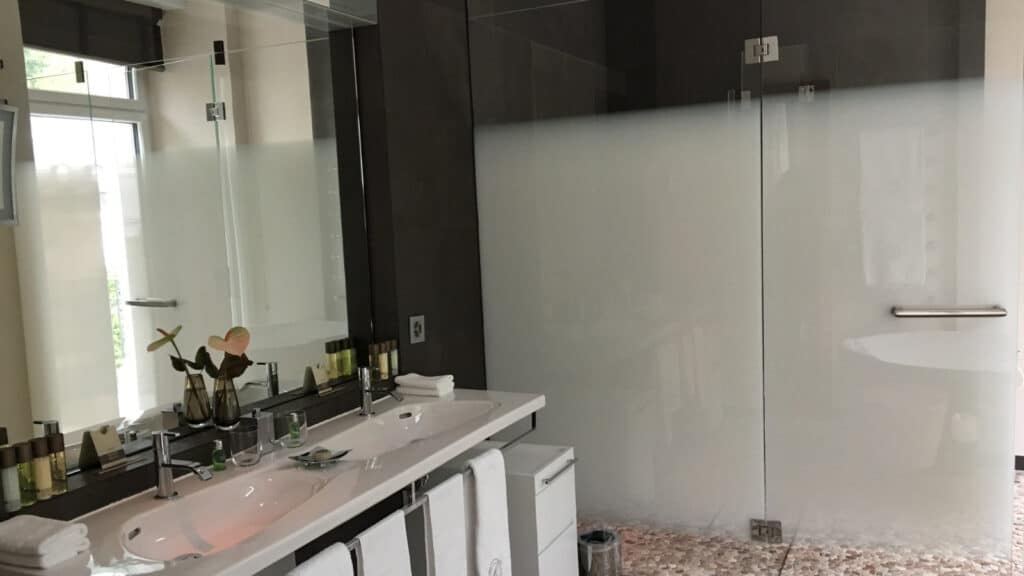
This is where the demands of hospitality become particularly interesting. A good showerhead must not only use less water; it must also feel generous.
The challenge therefore concerns not only flow rate, but also perceived pressure, spray pattern, droplet size, aeration and thermal comfort.
Some technologies go further still, using recirculation systems or devices that make guests aware of their consumption in a more engaging and less guilt-inducing way. Accor is experimenting with Luniwave solutions designed to reduce shower water consumption while seeking to preserve the guest experience.
This is where the idea of enhancement really comes into its own.
Resource efficiency does not necessarily mean offering less. It requires better design.
Not all CAPEX is created equal
The risk, naturally, would be to go too far in the opposite direction: investing in technology simply because it promises to save water.
A sophisticated solution is worthwhile only if it is suited to the property.
Its installation cost, return on investment, energy consumption, maintenance requirements, footprint, lifespan, availability of spare parts, health constraints and the ability of hotel teams to operate it all need to be considered.
A poorly maintained greywater reuse system is not a good solution.
Nor is a showerhead so water-efficient that guests simply stay in the shower longer to achieve the comfort they expect.
Or a complex tap system that needs to be replaced prematurely.
Resource efficiency is not about adding technology, but about eliminating what serves no purpose and investing where it genuinely makes a difference. Once again, the challenge is to strike the right balance between performance, comfort, operational robustness and whole-life cost.
The best time is often during construction or renovation
An existing hotel can already take action in many areas without undertaking major works:
- Adjusting flow rates.
- Detecting leaks.
- Sub-metering.
- Maintenance.
- Optimising swimming pool operation.
- Reviewing laundry and housekeeping procedures.
But a major renovation or new-build project opens up far greater possibilities.
This is the point at which separate pipework can be incorporated, space allocated for treatment or storage equipment, rainwater harvesting organised, greywater recovery considered, sanitary fittings selected, laundry operations addressed and landscaping designed around actual water requirements.
Once risers, pipework and plant rooms have been fixed, some solutions naturally become far more difficult and expensive to integrate.
This is therefore very much a matter of CAPEX strategy, provided it is approached in terms of whole-life cost rather than initial expenditure alone.
For the client and its project management adviser, the challenge is not to select a technology themselves or carry out its technical design.
It is to raise the right questions early enough, involve the relevant specialists and enable informed decisions to be made between investment, operating savings, maintenance and quality of use.
Reconciling high standards and enjoyment
I come back, finally, to my bath.
I do not believe that the future of water management in hospitality comes down to telling guests that they must take shorter showers and give up everything that gives them pleasure.
That can, of course, form part of individual awareness.
But hotels have far more interesting levers available to them:
- Avoid losing water through their networks.
- Avoid unnecessarily heating water that will simply be discharged.
- Match water quality to its intended use.
- Reuse it where appropriate.
- Choose equipment that uses less without giving less.
- And above all, design installations that reconcile efficiency, quality of use and enjoyment.
Good resource efficiency does not mean a diminished experience. It eliminates waste without reducing perceived quality.
So yes, water efficiency and an enhanced guest experience can go hand in hand.
Sometimes, they can even reinforce one another.
Because using a resource intelligently does not necessarily mean doing less. It means making better use of what we already have.